Harbor Plaque Co · specification guide
Boat name plaque layout and lettering guide
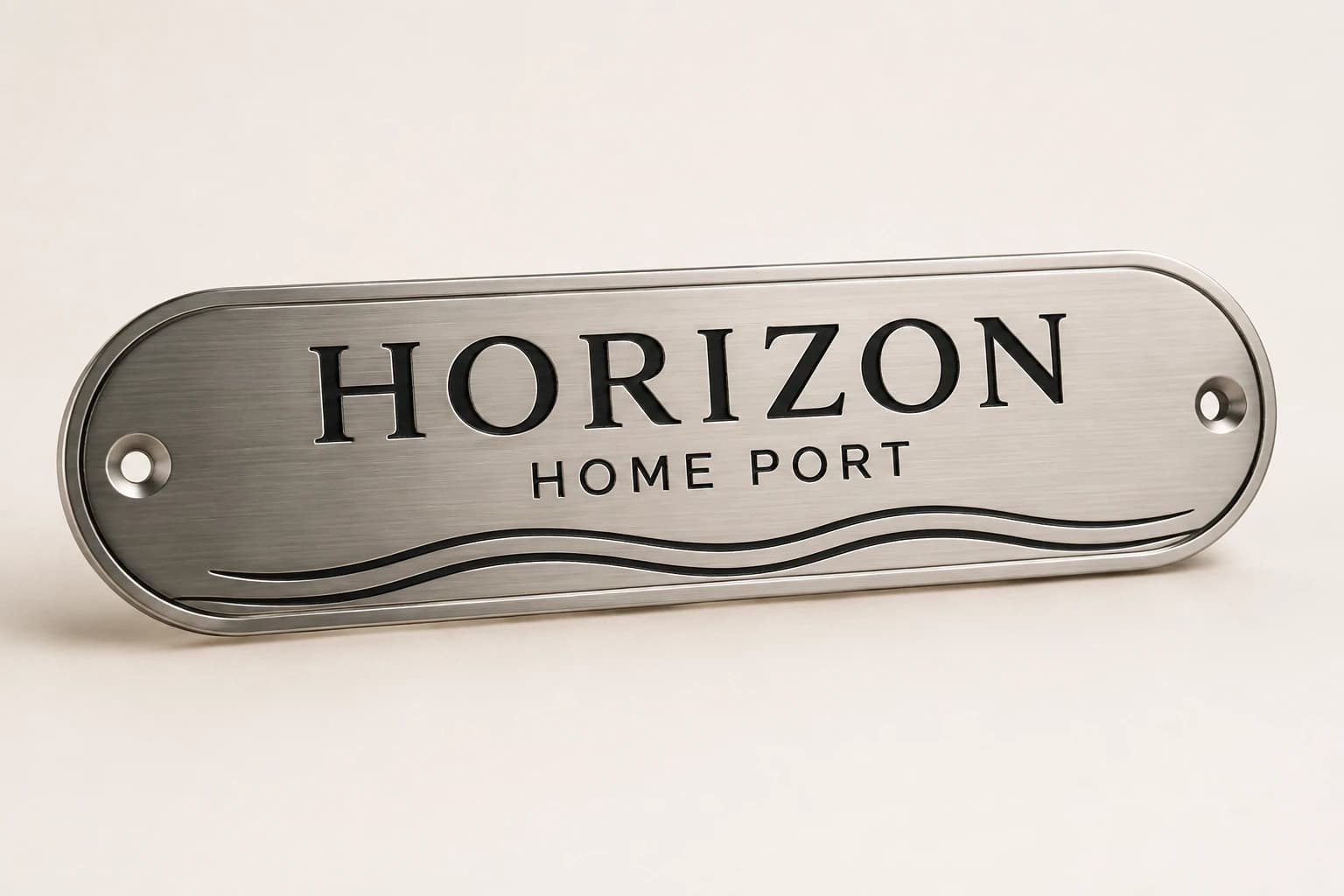
Put the boat name on top in the largest letters, then the hailing port, city and state, smaller underneath. Keep the name to one line if you can. Harbor Plaque Co makes decorative boat nameplates and ships worldwide, but a plaque is not your legal hull marking unless it meets the federal rules for documented vessels.
Reviewed 2026-09-05 · AI-assisted editorial review. General buying guidance; illustrative scenarios are not customer case studies. Images are AI-generated concepts.
This guide covers name-only versus name and hailing port, letter height for the distance people read from, script versus block letters, curved mounting spots, and the documented-vessel rules cited from federal regulations. We engrave the layout you approve. We do not decide whether a marking satisfies the Coast Guard, your state or an inspector. The National Vessel Documentation Center answers documentation questions.
- Name on top, largest. Hailing port below, about half the height.
- Block letters read farther away than script.
- Plan letter height from the distance people will read it.
- Measure the mounting spot, including any curve, before choosing a size.
- Documented boats still need the required hull markings, plaque or not.
Should the plaque show just the name, or the hailing port too?
Use the name alone for a helm, cabin, dinghy or gift plaque. Add the hailing port when the plaque copies the look of the stern lettering or the owner wants the home port shown. A name-only plaque can use bigger letters on the same plate, so it reads from farther away.
If you add a hailing port, write it the way the boat uses it, such as "Annapolis, MD." For documented recreational boats, the official marking puts the name and hailing port together on the hull, and the hailing port must be a US place that includes the state. A decorative plaque can match that wording, but it does not replace the marking. Inside the cabin, many owners prefer the name with a short line such as the year launched.
- Helm or cabin: name only, or name plus year.
- Transom-style replica: name plus hailing port.
- Gift for a new owner: name plus a short line, such as a launch date.
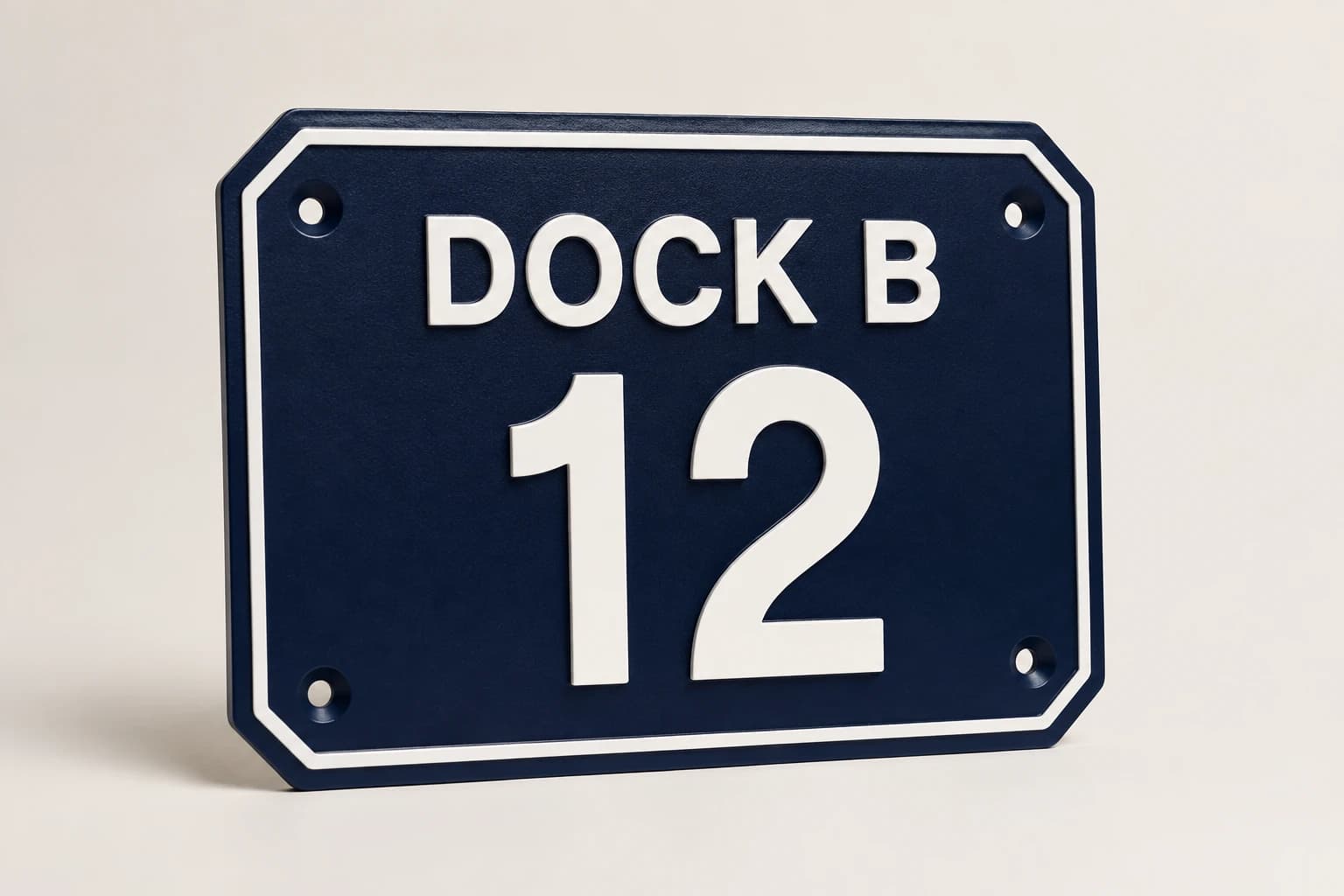
- Dock or slip: name plus slip number, using the Dock & Slip Number Sign style.
How big should the letters be on a boat name plaque?
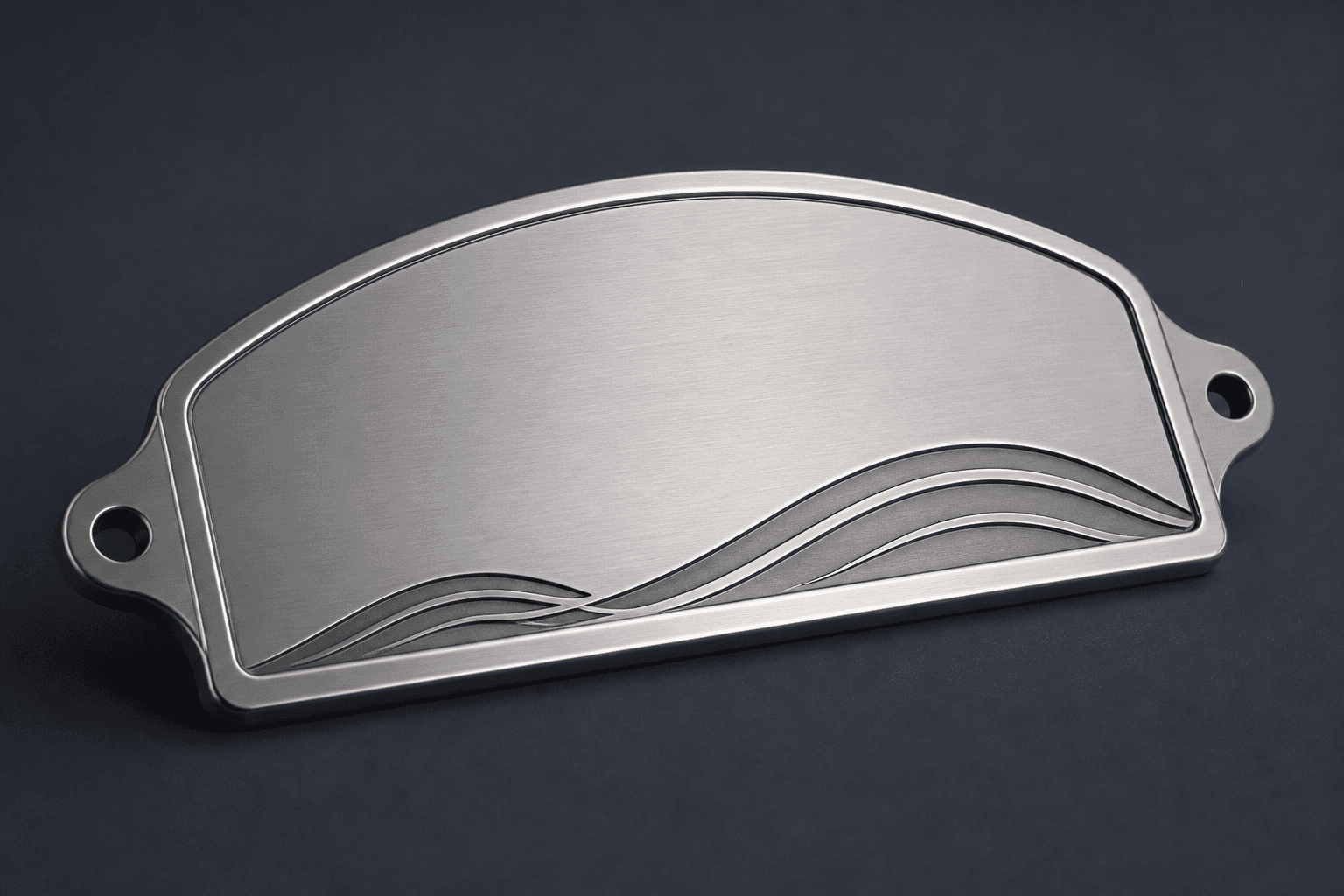
Plan letter height from the farthest distance someone needs to read the name. Our planning rule of thumb is about one inch of capital-letter height for every ten feet of viewing distance, and block letters do better than script. It is a starting point, not a standard. Harbor Plaque Co confirms the size on an actual-size proof.
A helm plaque read from three or four feet can use small letters. A plaque meant to be read from the dock at 30 feet needs about three-inch letters by that rule. Our Custom Boat Nameplate is listed at 8 to 16 inches wide, so a long name at large letter heights may not fit. Shorten the line, use a second line, or ask whether we can quote a larger plaque.
- 3 to 5 feet (helm, cabin door): about 1/2 inch letters
- 10 feet (cockpit, across a small dock): about 1 inch
- 20 feet (dock walkway): about 2 inches
- 30 feet and up (across the slip): about 3 inches or more
Is script or block lettering better for a boat name?
Block and simple serif letters are easier to read at a distance, in glare and at an angle. Script looks classic but loses legibility when letters are small or the name is long. A good compromise is a script name with a block hailing port, with the name kept short and the script letters large.
Avoid very thin strokes, tight letter spacing and all-caps script. Each of these makes letters blur together from the dock. If you love a script font, test it: print the name at actual size, tape it where the plaque will go, and step back to the distance you care about. If you cannot read it in two seconds, choose a bolder style or a bigger plaque.
Can a boat name plaque go on a curved surface?
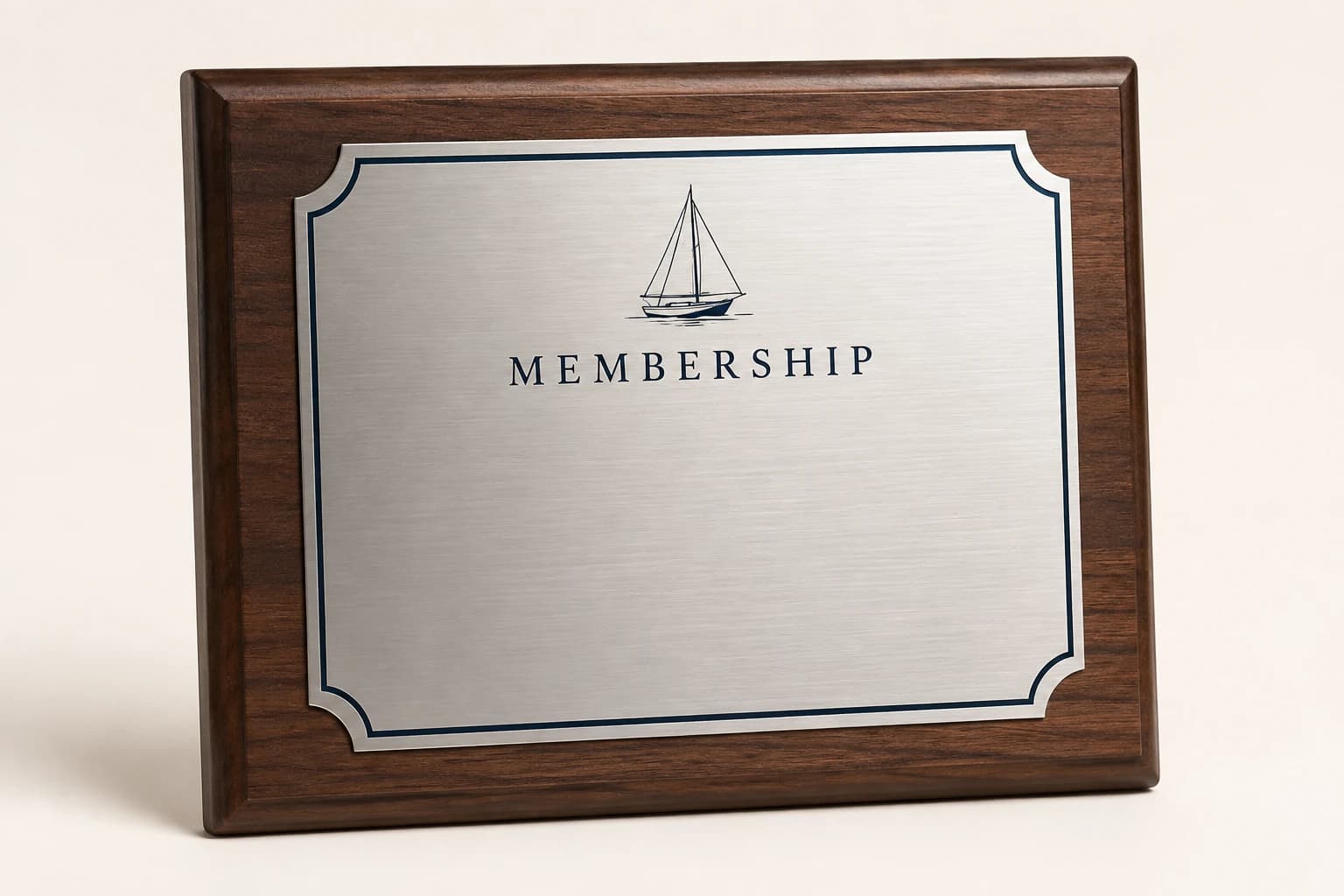
Our boat nameplates are flat plates in metal or composite, so they suit flat or nearly flat spots best. Many transoms and cabin sides curve. Measure the spot and check the curve before ordering. Harbor Plaque Co can size a plaque to fit a flatter area, and the installer decides spacers and fasteners.
To check, hold a straight edge across the spot and measure the largest gap under it. Send us the width and height of the flat area, the gap, and a photo with a tape measure in view. Mounting hardware and installation are quoted separately. Tell us whether the plaque will see salt spray, fresh water or only cabin air, so we can suggest a material for that location.
Check your boat name line lengths
The example loads the two final lines from the illustrative helm plaque. Replace them with your boat name and hailing port.
Method: Counts visible characters, spaces and punctuation by line against the characters-per-line budget you enter. It does not establish physical fit, legibility at distance or any marking requirement.
Build your plan
Counts include spaces and punctuation. Character count cannot establish physical fit: font, script, layout, material and engraving area require a proof at actual size.
What are the USCG rules for documented boat names?
For a vessel documented only for recreation, federal rules require the name and hailing port marked together on a clearly visible exterior part of the hull. The letters must be clearly legible Latin letters or Arabic or Roman numerals at least four inches high, made with any durable means. The rule is 46 CFR 67.123.
The hailing port must be a US place that includes the state, under 46 CFR 67.119. Documented boats also need the official number, preceded by "NO.," in block numerals at least three inches high on an interior structural part of the hull, fixed so removal would be obvious, under 46 CFR 67.121. A documented name cannot be changed without prior approval from the Director of the National Vessel Documentation Center, under 46 CFR 67.117.
A decorative Harbor Plaque Co nameplate does not replace any of these markings, and we do not say it meets them. If you want a plate to serve as the hull marking, check with the National Vessel Documentation Center first and tell us the requirement you need to meet. State registration numbers are a separate rule: 33 CFR 173.27 requires block characters at least three inches high on each side of the forward half of the boat, contrasting with the hull.
Sources: Electronic Code of Federal Regulations (U.S. Coast Guard rule): 46 CFR 67.123: Name and hailing port marking requirements; Electronic Code of Federal Regulations (U.S. Coast Guard rule): 46 CFR 67.119: Hailing port designation; Electronic Code of Federal Regulations (U.S. Coast Guard rule): 46 CFR 67.121: Official number marking requirement; Electronic Code of Federal Regulations (U.S. Coast Guard rule): 46 CFR 67.117: Vessel name designation; Electronic Code of Federal Regulations (U.S. Coast Guard rule): 33 CFR 173.27: Numbers: display; size; color
Boat name and hailing port layout examples, with character counts
These examples are grouped by length so you can see how a name fits before you choose a plaque. Counts include letters, spaces and punctuation. Short names allow the biggest letters on a given plate. Long names need smaller letters or two lines. All names below are original examples. Confirm the real fit on your proof.
Paste your own name and hailing port into the Engraving Text Length Checker to compare them.
- Short names (under 8 characters):
- "Osprey" (6 characters)
- "Kestrel" (7 characters)
- "Driftly" (7 characters)
- "Tidal" (5 characters)
- "Low Key" (7 characters)
- "Salt Jr" (7 characters)
- "Ripple" (6 characters)
- Medium names (8 to 14 characters):
- "Second Wind" (11 characters)
- "Quiet Hours" (11 characters)
- "Knot Working" (12 characters)
- "Sea Biscuit II" (14 characters)
- "Lucky Penny" (11 characters)
- "Blue Heron" (10 characters)
- "Weekend Pass" (12 characters)
- Long names (over 14 characters, plan small letters or two lines):
- "Northern Promise" (16 characters)
- "Afternoon Delight" (17 characters)
- "Grandpa's Retirement" (20 characters)
- "Miss Caroline Rose" (18 characters)
- "Reel Therapy Two" (16 characters)
- Hailing port lines:
- "Annapolis, MD" (13 characters)
- "Bayfield, WI" (12 characters)
- "Newport, RI" (11 characters)
- "Port Aransas, TX" (16 characters)
- "Saint Petersburg, FL" (20 characters)
- "Sausalito, CA" (13 characters)
- "Charleston, SC" (14 characters)
Illustrative example: fitting a long name on a helm plaque
In this made-up example, an owner wants a helm plaque reading "Miss Caroline Rose" (18 characters) with "Saint Petersburg, FL" (20 characters) below. The plaque will be read from about four feet. The owner first picks a script font for both lines and a 10-inch plate.
At that width, both long lines force small script letters. The owner tests a printout at actual size and finds the hailing port hard to read. The final layout keeps the name in script on one line, sets the port in block capitals as "ST. PETERSBURG, FL" (18 characters), and moves to a 14-inch plate. The boat is documented, so the owner keeps the four-inch hull lettering as the legal marking and treats the plaque as decoration only. Harbor Plaque Co sends an actual-size proof for approval.
Decorative plaque or required marking: what is the difference?
A boat can carry several kinds of name or number markings, each with a different job. A decorative plaque is a design choice. A documented vessel marking and a state registration number are set by federal rules. This table compares them so you know which one a Harbor Plaque Co nameplate is.
| Option | Where it goes | Size rule | Who decides |
|---|---|---|---|
| Decorative boat name plaque | Helm, cabin, transom, dock | Your choice; confirm on the proof | The owner |
| Documented recreational vessel name and hailing port | Together on a clearly visible exterior part of the hull | Letters at least 4 inches high (46 CFR 67.123) | Federal rule; ask the NVDC |
| Official number | Interior structural part of the hull, after "NO." | Block numerals at least 3 inches high (46 CFR 67.121) | Federal rule; ask the NVDC |
| State registration number | Each side of the forward half | Block characters at least 3 inches high (33 CFR 173.27) | Federal rule and your state agency |
Boat name plaque questions
These answers repeat the key points so each one stands alone. Harbor Plaque Co makes decorative boat nameplates and ships worldwide. We do not decide whether any plate meets Coast Guard or state marking rules, and we do not make that claim. Check documentation questions with the National Vessel Documentation Center.
How much does a custom boat name plaque cost and how long does it take?
The Custom Boat Nameplate is listed at $39 to $89 per nameplate, depending on material and size within its 8 to 16 inch width range. Harbor Plaque Co production takes no more than 7 days after proof approval, plus shipping. Mounting hardware and installation are quoted separately. Your written quote confirms price, start date and delivery.
Does a boat name plaque count as the legal hull marking?
Not by default. For a documented recreational vessel, 46 CFR 67.123 requires the name and hailing port together on a clearly visible exterior part of the hull, in letters at least four inches high, by durable means. Our decorative plaques are not sold as meeting that rule. Ask the National Vessel Documentation Center before relying on any plate.
How should the hailing port be written?
Write the city and state, such as "Annapolis, MD," and match how the boat uses it. For documented vessels, 46 CFR 67.119 requires the hailing port to be a US place that includes the state, territory or possession. On a decorative plaque, set it below the name in smaller letters, often about half the name height.
What letter height should I choose?
Our planning rule of thumb is about one inch of capital-letter height for every ten feet of viewing distance, with block letters reading better than script. It is a starting point, not a standard. A helm plaque can use half-inch letters; a plaque read from 30 feet needs about three inches. We confirm on an actual-size proof.
Can I rename my boat and order a new plaque right away?
You can order a decorative plaque any time. For a documented vessel, 46 CFR 67.117 says the name may not be changed without prior approval from the Director, National Vessel Documentation Center, so finish that step before repainting the hull. Many owners order the plaque after approval so the spelling matches the new documents.
What do you need to make my boat name plaque?
Send the name and hailing port exactly as you want them, the font style, the mounting spot size and any curve, and a photo. Tell us whether it will face salt spray, fresh water or indoor air. Harbor Plaque Co then sends a written quote and an actual-size proof for you to approve.
Sources and scope
The sources below support the cited technical details. The ordering workflows are editorial recommendations. Your project specification, price and schedule are established in the written quote and approved proof.
- Electronic Code of Federal Regulations (U.S. Coast Guard rule): 46 CFR 67.123: Name and hailing port marking requirements · checked 2026-10-03
- Electronic Code of Federal Regulations (U.S. Coast Guard rule): 46 CFR 67.119: Hailing port designation · checked 2026-10-03
- Electronic Code of Federal Regulations (U.S. Coast Guard rule): 46 CFR 67.121: Official number marking requirement · checked 2026-10-03
- Electronic Code of Federal Regulations (U.S. Coast Guard rule): 46 CFR 67.117: Vessel name designation · checked 2026-10-03
- Electronic Code of Federal Regulations (U.S. Coast Guard rule): 33 CFR 173.27: Numbers: display; size; color · checked 2026-10-03
Which buying guide should you read next?
All buying guidesGive the berth a stable location identity and the vessel its approved personal name, then decide which physical pieces should change when occupancy changes.
Count complete two-sided direction-sign assemblies for the order, then maintain a separate face schedule for wording and orientation approval.
Keep fixed berth identity separate from boat names and temporary marina information. Approve the location, reading direction and mounting for each sign, then group the order by dock or vessel. Recognition awards and commemorative pieces need their own presentation schedule.
Brief the actual exposure, support and maintenance conditions before selecting a marina sign material, and compare complete proposals instead of generic durability labels.