Harbor Plaque Co · buyer guide
Replacement slip signs and numbering continuity
For Harbor Plaque Co worldwide orders, a missing or damaged slip sign usually prompts a request to restore an existing location identifier. Start by confirming the current approved number and the exact physical location. Do not infer the value solely from neighboring signs, since the marina may use deliberate gaps, suffixes or a sequence that is not obvious from one viewpoint.
Reviewed 2026-09-05 · AI-assisted editorial review. General buying guidance; illustrative scenarios are not customer case studies. Images are AI-generated concepts.
Ask the responsible marina contact whether this is a like-for-like replacement or part of an approved numbering change. The answer determines the source record and review scope. A replacement purchase should not silently redesign the marina's location system because a coordinator believes a different sequence would look tidier. Confirm that distinction in writing before requesting the final proof.
How do you build a location-first replacement list?
Use one row for each affected slip or sign position. Include the dock reference, full approved identifier, current sign condition and proposed action. Keep locations requiring no new sign in the broader survey if they help explain the sequence, but exclude them from the new-purchase quantity.
Attach a photograph or other approved reference that identifies the actual location without relying on a generic image of a dock. A close-up of a worn panel may show the old number but not where it belongs. The reviewer should be able to connect the replacement text to the marina's authoritative location record.
How do you preserve prefixes, leading zeros and suffixes?
Copy the approved identifier exactly. A-04, A-4 and 4 should not be treated as automatically equivalent strings. Their meaning depends on the marina's system. Ask for a deliberate decision if the current source conflicts with an existing sign. Preserve the authorized formatting.
Keep spreadsheet cells formatted to preserve the intended text. A numeric conversion can remove leading zeros or alter a mixed identifier. Review the exported production file, not only the original worksheet view. The maker should receive the final visible string and should not be expected to restore formatting that was lost during data handling.
How do you match the physical replacement scope?
Provide the existing panel and support specification if it is reliable and current. Otherwise, ask the maker what measurements or sample information are needed. Record dimensions, attachment details and the actual conditions relevant to the proposed location review. Identify any uncertain measurements.
A similar color or material name does not establish a match. Ask the proposal to identify expected differences in appearance or construction where exact reproduction is not confirmed. The marina can then choose between an accepted local replacement and a broader planned refresh. Do not promise an invisible match from a photograph when the actual finish and dimensions have not been established.
Illustrative example: How do seven replacements and two specified spares total nine?
Imagine a fictional marina replacing seven current slip signs and deliberately ordering two additional copies as specified spares. Seven plus two equals nine physical pieces. The quantity example uses seven main units, one each, zero category extras and two spares. It returns nine total pieces.
The worksheet lists seven replacement references and two spare references without inventing actual slip numbers. In a real order, each spare needs an approved legend or an explicitly scoped blank treatment. A spare total alone does not tell the maker which number to repeat.
If one of the seven locations turns out to have a usable retained sign, remove that replacement from the new-purchase scope. The total becomes eight while the survey still contains the location. If the marina instead authorizes a new numbering scheme, pause the like-for-like list and create the approved mapping before releasing revised text.
Count replacement signs and specified spares
Load the fictional worked example, then replace every assumption with your approved project inputs.
Method: Calculate only the entered physical counts. The result does not choose specifications, authorize wording or reserve production.
Build your plan
Set spares yourself. This calculates the quantities you enter; it does not assume a recommended buffer.
Use the article’s example files
Fictional example rows show how to separate physical quantities, wording and approval references. Replace them with your project schedule. HOLD and SAMPLE entries are not production instructions.
How do you check the complete sequence without inventing continuity?
Review the replacement list against the authoritative marina schedule and nearby identifiers. The purpose is to catch transcription or assignment errors, not to enforce an assumed uninterrupted sequence. Ask the marina owner to explain a gap or suffix rather than filling it automatically.
Where the same slip number appears on several docks, use the full internal location reference in production and packing records. The visible design may use the marina's approved short form, but the order still needs an unambiguous destination. This prevents a correct number from being delivered to the wrong dock simply because the label text looks familiar.
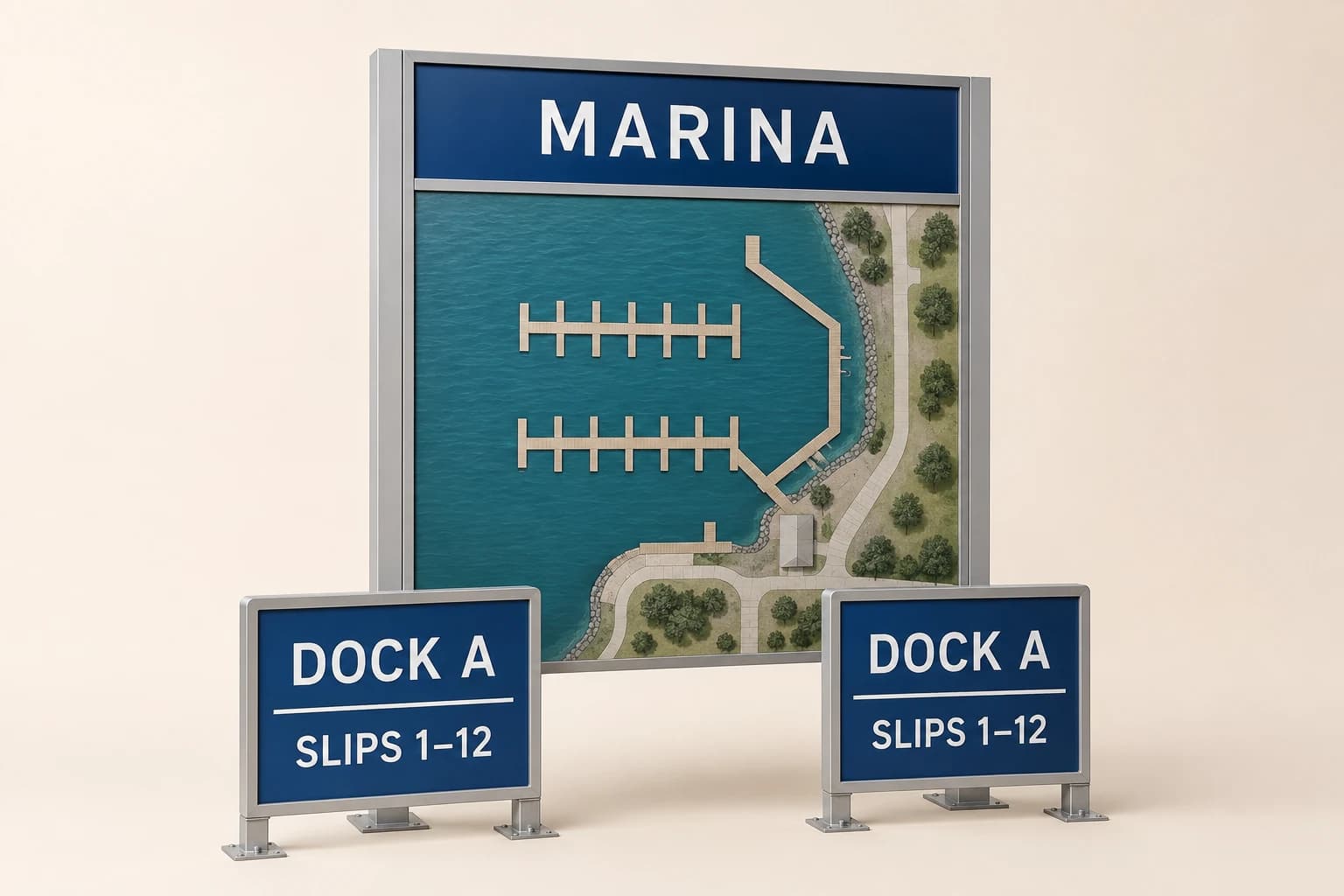
How do you review text and placement as connected approvals?
Have the authorized contact approve the exact identifier and the location assignment. Have the appropriate project reviewer assess the physical replacement specification. A spelling-style approval cannot confirm a support fit, and a fit check cannot confirm that the panel belongs at the listed slip.
For a batch of similar signs, review a complete proof index that includes every approved identifier. Do not approve only a sample number while assuming the rest of the sequence is correct. A duplicated number and a missing number can leave the total quantity unchanged, so the review must inspect the actual list.
How do you pack in an order useful to the replacement team?
Group replacements by dock and the approved installation sequence. Keep specified spares separate from active replacements and label their status. The person distributing panels should not have to guess whether an extra copy belongs at a second location or is intended for storage.
At receipt, reconcile the identifiers and quantities against the released list. After authorized placement, update the project record with completed and unresolved locations. A carton delivered to the marina office is not evidence that the numbering continuity has been restored at every affected slip.
How do you retain a practical reorder record?
Store the accepted text, physical specification and location reference for each replacement type. If the next request is another copy of the same sign, the maker can scope it against that record. If the conditions or support have changed, obtain a revised review rather than assuming the old specification remains appropriate.
Keep any planned numbering change separate from the current replacement inventory. An unused panel carrying an old identifier should not be accidentally installed after a new scheme is approved. The marina's responsible coordinator should control that transition and identify which stored pieces remain usable under the current location system.
How do you handle an unreadable original without guessing?
When the old panel is too worn to read, gather the location reference and ask the marina to confirm the identifier from its approved records. A photograph can document the condition and support a replacement request, but it cannot supply missing characters with certainty. Mark the text on HOLD until the responsible owner resolves it.
If the marina's records disagree with nearby signs, identify the conflict explicitly. The solution may be a record correction, a like-for-like panel or a wider numbering review. The sign maker should not choose among those possibilities based on what fits a convenient template.
Once the identifier is confirmed, show the complete visible string in the proof and keep the approval reference with the location row. If the existing support cannot be measured reliably, treat that as a separate unresolved physical question. Confirming the number does not confirm the replacement's dimensions.
This two-part approach is useful because worn signs can hide both content and construction details. Resolve each from an appropriate source and release only the accepted combination. It is better to make the remaining uncertainty explicit than to produce a plausible-looking panel that cannot be confidently assigned or fitted.
How do you preserve numbering history when changes are intentional?
If the marina authorizes renumbering, keep an old-to-new mapping with the effective project revision. Do not erase the old values from every working record before the physical change has been reconciled. The marina should coordinate any dependent operational records through its normal process.
A like-for-like replacement is a different scope. It should reproduce the approved current identifier without turning a worn sign into an opportunity to simplify prefixes or close gaps in a sequence. The coordinator should ask which of those two purposes applies before preparing artwork.
Which option fits this order?
Choose like-for-like replacement, approved renumbering or specified spare copies according to the marina’s actual decision. Seven replacements and two deliberate spares make nine physical pieces in the example. Compare exact identifiers, destination records and retained hardware so a worn sign does not trigger an unauthorized new numbering scheme or an assumed visual match.
| Option | Useful when | Scope to resolve |
|---|---|---|
| Like-for-like replacement | A current approved identifier needs a new physical piece. | Exact text, destination and confirmed replacement specification. Boat Outfitters identifies its dock sign construction as King ColorCore. |
| Approved renumbering | The marina has deliberately changed its location system. | Old-to-new mapping, effective revision and coordinated dependent records. |
| Specified spare | An extra approved copy is intended for controlled storage. | Exact legend or confirmed blank scope, quantity and separate inventory status. |
What should buyers confirm before ordering?
Replacement slip signs need confirmed identifiers and physical specifications before release. Cost can change with matching work, retained supports and deliberate spare copies. These answers explain unreadable originals, leading zeros and numbering gaps so a plausible-looking panel is not mistaken for an authorized restoration of the correct marina location.
What affects the cost of replacement slip signs?
Harbor Plaque Co quotes should identify the exact replacement text, retained support, confirmed dimensions and any matching work or new components required. Specified spare copies are another explicit quantity. A similar appearance in a photograph is not enough to price a guaranteed match or assume that every replacement fits the existing hardware.
Can we infer a missing number from adjacent slips?
Use the marina’s authoritative location record. Neighboring signs are context, not automatic proof of the correct identifier. Ask the authorized marina contact to resolve gaps, prefixes or suffixes before release. The coordinator should not create a tidier sequence as an incidental design choice during a like-for-like replacement purchase.
Should leading zeros be preserved?
Preserve the exact approved display string unless the marina authorizes a change. Check exports so spreadsheet formatting does not alter it. Treat identifiers as exact text throughout the production export. A numeric spreadsheet conversion can remove formatting even when the original worksheet looked correct, so inspect the final file sent for the proof.
Does a matching material name guarantee a visual match?
No. Actual dimensions, finish, age and construction need review. Ask the proposal to state what matching is confirmed and what may differ. Ask the proposal to state any expected difference and have the marina accept it explicitly. A local replacement and a broader visual refresh are different purchasing decisions with different scope.
What should happen when the original number is unreadable?
Use the marina’s approved location record to confirm the full identifier and keep the text on HOLD until that decision is made. A worn panel and nearby numbers can provide context but cannot supply missing characters with certainty. Resolve physical measurements separately; confirming the number does not confirm the panel’s fit.
Sources and scope
The sources below support the cited technical details. The ordering workflows are editorial recommendations. Your project specification, price and schedule are established in the written quote and approved proof.
- Boat Outfitters: Custom Horizontal Dock Sign · checked 2026-09-05
Which buying guide should you read next?
All buying guidesGive the berth a stable location identity and the vessel its approved personal name, then decide which physical pieces should change when occupancy changes.
Brief the actual exposure, support and maintenance conditions before selecting a marina sign material, and compare complete proposals instead of generic durability labels.